Problem and Constraints
Patients need to describe their symptoms before a visit and remember clinician instructions afterward. Visit Smoothie collects and organizes patient-confirmed information without making diagnoses or setting medication doses. The result is a local prototype, not a service deployed for real patients.
My Responsibilities
I developed Visit Smoothie together with friends at a hackathon during Stanford Venture Trip and was involved across all modules. We collaborated on the patient workflow, interface, AI-assisted collection and organization, and integration. No module is attributed exclusively to me.
System Overview
Before a visit, onboarding and body-map intake help patients record symptoms, confirm their wording, and prepare a report for a clinician. After a visit, Clinical Plan organizes clinician instructions and follow-up reminders. Account, provider-selection, transcription, report, and settings flows support the workflow. Risky situations direct patients toward medical care.
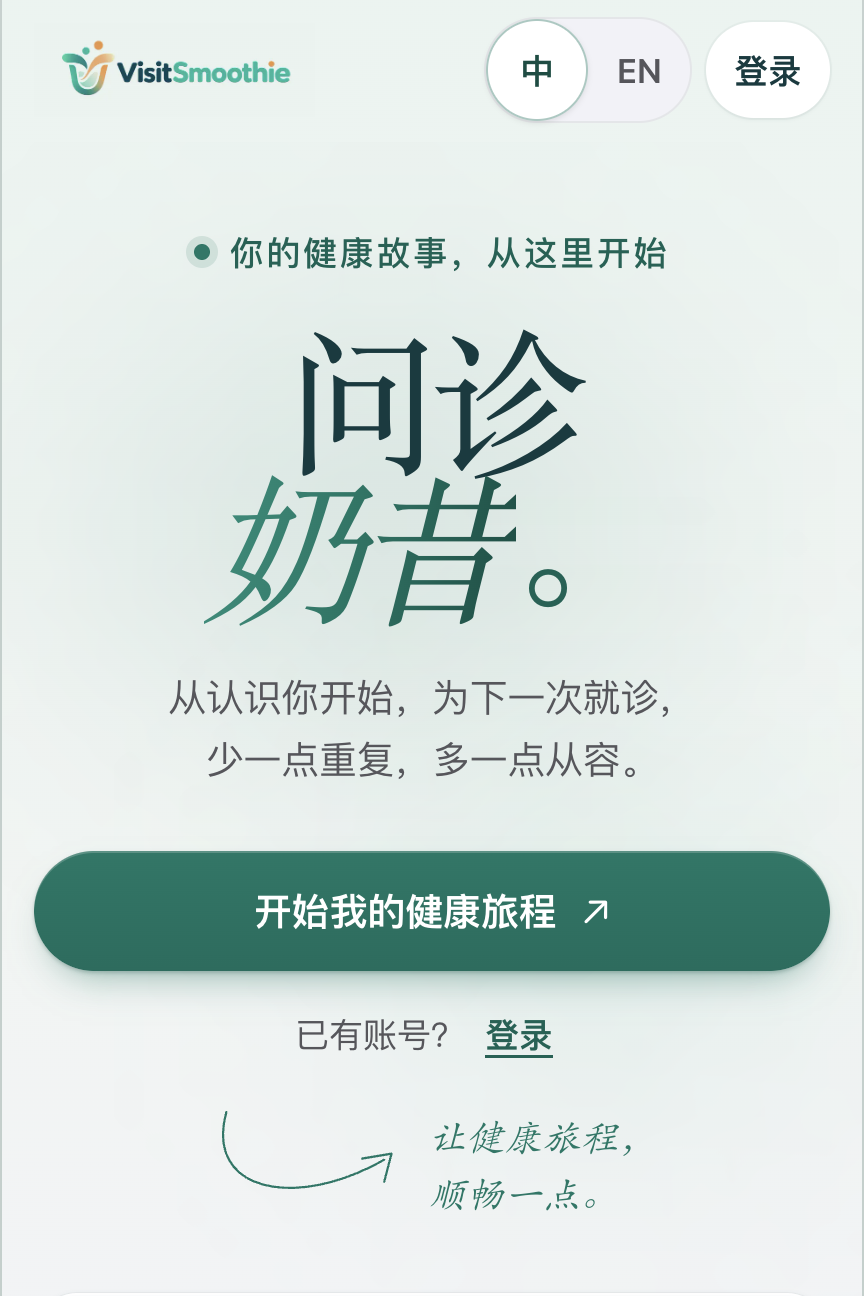
The screenshot above shows the prototype’s Chinese welcome screen, with a Chinese/English switch, registration entry and login. It is an interface example, not evidence of clinical effectiveness.
Implementation Process
The prototype uses Next.js on Node 24, encrypted server-side SQLite storage, and server-side AI-provider calls with rule fallback. Photo and transcription features require configured credentials. The fixed interface supports English and Chinese; generated and rule-based text remains primarily Chinese. Patient confirmation keeps summaries grounded in patient input and clinician instructions rather than independently choosing treatment.
Testing and Iterations
Project records describe engineering checks and synthetic-patient scenarios. They support prototype integration, not clinical effectiveness. Real long recordings, real photo inputs, and notification permission have not undergone human trials. Reminders depend on app or browser availability.
Results
Our team won the Grand Prize at the Stanford Hackathon with Visit Smoothie.
The completed local prototype connects symptom intake, patient-confirmed reports, and post-visit instruction organization. It has not been deployed for real patient use. Public deployment, HTTPS, operational key management, medical review, and further privacy safeguards remain work. No measured clinical benefit is claimed.
Failures and Lessons
Feature availability and reminder delivery depend on configuration and runtime conditions. A visible control alone cannot establish that a workflow works in practice. The project reinforced the need to distinguish patient wording, clinician instructions, and generated organization, and to test real input and delivery conditions before making reliability claims.
Source note: October 4 repository README and handoff documentation, plus the owner’s account of collaborative contributions and October 5 confirmation of the project name and award. Source repository (private; authorized collaborators only). No patient records or private operational details are published.
问题与约束
患者需要在就诊前描述症状,并在就诊后记住医生的说明。Visit Smoothie 收集和整理由患者确认的信息,不作诊断,也不设定药物剂量。目前成果是本地原型,尚未部署供真实患者使用。
我的职责
我在 Stanford Venture Trip 期间的黑客松中与朋友共同开发 Visit Smoothie,并参与了所有模块。我们协作推进患者流程、界面、AI 辅助信息收集与整理及系统集成,不将任何模块独占归于我。
系统概览
就诊前,引导流程与人体图症状录入帮助患者记录不适、确认自己的表述,并为医生准备报告。就诊后,Clinical Plan 整理医嘱和后续提醒。账户、模型服务商选择、转写、报告和设置流程为此提供支持。遇到风险情况时,应用引导患者寻求医疗帮助。
上方截图展示原型的中文欢迎页,包括中英文切换、注册入口和登录。这是界面展示,不代表临床有效性证据。
实现过程
原型使用 Node 24 与 Next.js、服务端加密 SQLite 存储,以及带规则回退的服务端 AI 服务商调用。照片和转写功能需要配置凭据。固定界面支持中英文,生成及规则文本仍主要使用中文。患者确认让摘要以患者输入和医生指示为依据,不自行选择治疗方案。
测试与迭代
项目记录描述了工程检查与模拟患者场景,可支持原型集成,不能证明临床有效性。真实长录音、真实照片输入和通知权限尚未经过真人试验。提醒依赖应用或浏览器可用。
成果
我们团队凭借 Visit Smoothie 获得了斯坦福黑客松大奖(Grand Prize)。
完成的本地原型串联了症状录入、患者确认的报告和就诊后医嘱整理,尚未部署供真实患者使用。公开部署、HTTPS、运行中的密钥管理、医疗审核和进一步隐私保护仍待完成,不声称已测得临床收益。
问题与经验
功能可用性和提醒送达依赖配置及运行条件,仅有可见按钮不能证明流程在实际使用中有效。项目让我更重视区分患者原话、医生指示和生成的整理内容,并在提出可靠性结论前测试真实输入及送达条件。
来源说明:10 月 4 日仓库 README、交接文档、本人对协作贡献的说明,以及 10 月 5 日对项目名称和奖项的确认。源码仓库(私有,仅授权协作者可访问)。不公开患者记录或内部运行细节。